Tuesday, December 14, 2010

Book Review: Uneven Ground

Failed Policies, Flawed Theories
And the Tragedy of Postwar Appalachia
Lexington: University Press of Kentucky, 2008
ISBN 978-0-8131-2523-7
By Ronald D. Eller

Reviewed by Kevin Barksdale
Published on H-Appalachia (March, 2009)

In Uneven Ground, historian Ronald D. Eller offers a Braudelian narrative of the social, economic, and political transformation of Appalachia after the Second World War. Focusing primarily on the relationship between relief and development efforts and the deteriorating postwar mountain communities and economy, Eller’s study stands as an indictment of failed governmental policies, faulty theories and models, and corporate greed and irresponsibility. From the acceleration of Appalachia’s postwar economy to the contemporary grassroots efforts to halt mountain-top removal mining practices, Uneven Ground covers a staggering amount of historical terrain and fills a long-overdue gap in the region’s historiography.

Uneven Ground’s six chapters are chronologically organized around the region’s most significant socioeconomic developments and challenges as well as the policies, policymakers, and organizations engaged in attempting to bring “progress” to mountain communities. Chapter 1 recounts the transformative decade following World War II in Appalachia. Eller argues that the expansion of Appalachia’s postwar economy was “flawed” and ultimately led to “growth without [infrastructural] development” (p. 11). As the coal industry boomed amid soaring markets and technological innovation, Appalachia experienced debilitating out-migration, increased absentee land ownership, environmental devastation, agricultural collapse, rising unemployment, and limited non-resource extraction economic development. Confronted with an increasingly desperate regional constituency, Appalachia’s political leadership proved ineffective in transcending the region’s corrupt “feudal political system” and providing resolutions to the systemic problems within the mountains (p. 35). The failure of native political leaders to offer solutions to rising regional poverty and economic inequality led to the widespread belief that federal intervention within the mountains was necessary to improve life in Appalachia.

To continue reading: Click Here.

Monday, December 13, 2010

Membership Records Management for Genealogical and Historical Societies

Announcing a web site dedicated to a project for developing a records management system for genealogical and historical societies.

PURPOSE
...to overcome the problems of genealogical and historical societies that do not own their own computer, do not have an office or paid staff to maintain records, whose officers are geographically separated with no access to a centrally maintained paper record filing system, where officer turnover often results in inconsistent methods of member record keeping, and where officers have varying degrees of aptitude with computer usage.

PROJECT DESCRIPTION
The solution is to use resources that may already be available to a society if they have a hosted website of their own. With a web database for member records, including contact information, dues status, a surname directory, and members' skills and interests data, the society's key officers can access the membership data on a need-to-see basis and avoid conflicts in record keeping and duplication of effort.

To read more: Click Here.

Sunday, December 12, 2010

Coal Creek

War and Disasters

Coal Creek Miners
The miners of Coal Creek, in Anderson County, Tennessee, left their mark on history. They fueled the industrial revolution. They fought the Tennessee Militia to abolish the use of convict miners by private industry during the Coal Creek War of 1891 to 1892. About 300 Coal Creek miners, many of them veterans of the Coal Creek War, perished in mine disasters in 1902 (Fraterville) and 1911 (Cross Mountain). Mine disasters like these raised public awareness of the hazards of mining, resulting in advances in mine safety practices. In the early part of the 20th century, thousands of coal miners died in the United States each year. In 2004, coal mining fatalities in the U.S. numbered 28. Here’s their story.

For the story of the Coal Creek War and the mining disasters of 1902 and 1911: Click Here.

Saturday, December 11, 2010

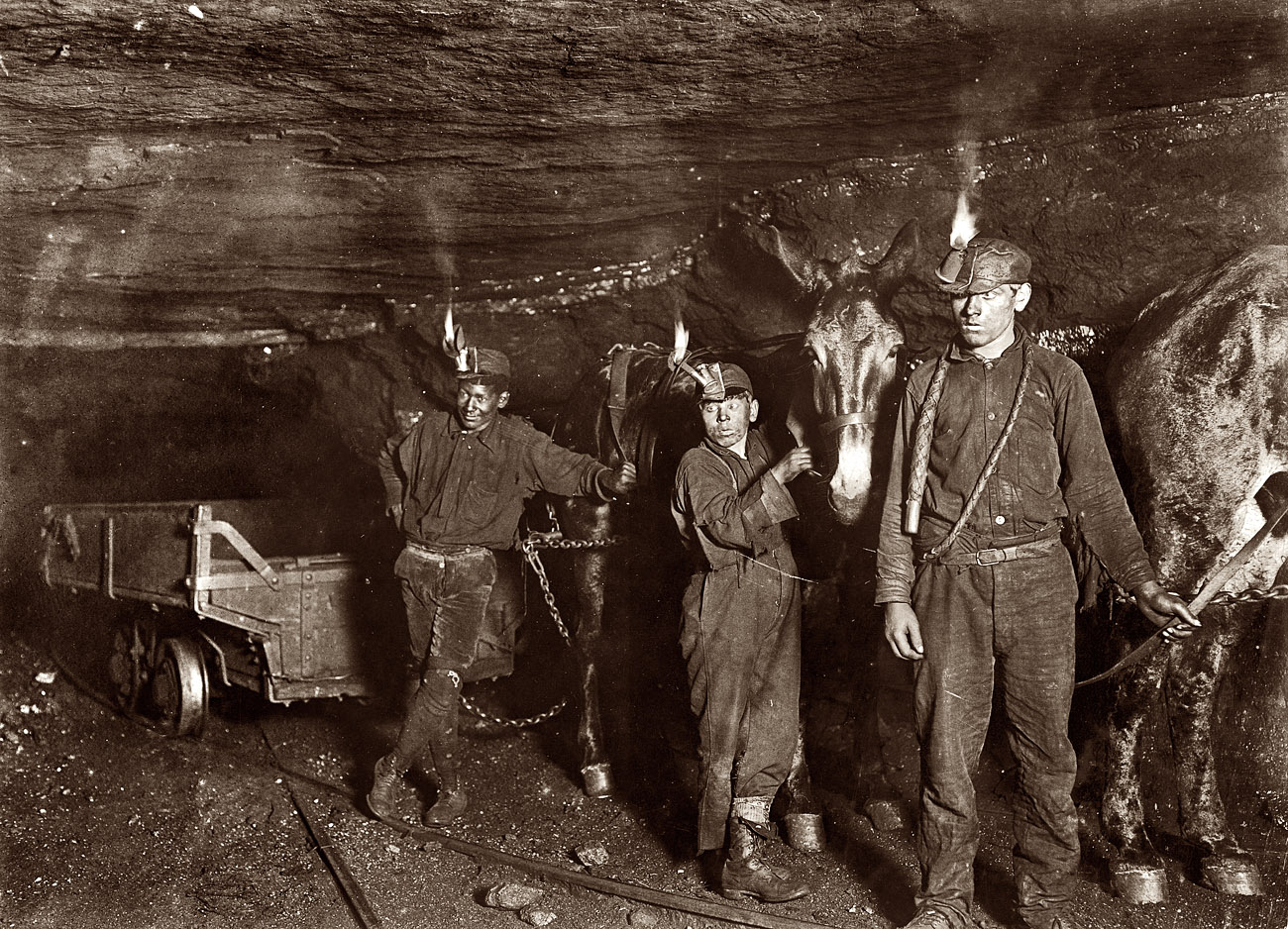
In the Tunnel

Miners with Open Flame Lamps, September 1908. Gary, West Virginia
When men first began to tunnel into the earth to remove coal, open flame lamps or candles were the only devices to light one's way. If a miner opened a pocket of lethal gas, the lack of oxygen could not only snuff out his open flame light — a warning too late — but the lives of miners also could be snuffed out. This is why miners often carried caged live canaries into the tunnels. Canaries are more sensitive than humans to diminished oxygen and poisonous gases and provided an early warning to miners. Even more obvious, an open flame could trigger an explosion or fire.

To continue reading: Click Here.

Friday, December 10, 2010

Bacon's Rebellion

And the Defeat of the Saponi Tribes
At Occoneechee Island

By Linda Carter

The story of the Great Trading Path, centered at Occoneeche Island in what is now Clarksville, VA, is inextricably intertwined with that of Bacon's Rebellion — the first rebellion American colonists were to wage against British governmental authority. It's fascinating how the paradigm with which one approaches a story colors one's perception of it. During the heyday of American expansionism, from the days of Andrew Jackson and his Removal policy towards Indians east of the Mississippi, on through the institution of hereditary slavery and later Jim Crow, researchers saw Bacon as something of a hero, an early version of George Washington, perhaps. The Virginia governor, William Berkeley, was painted in the light of a corrupt despot.

It wasn't until the 1950's, when thoughtful academics were horrified by the witchhunt tactics of McCarthyism, and inspired by the first stirrings of the Civil Rights Movement, that Bacon's Rebellion began to be seen in an entirely different light. Elements of evidence were uncovered in England, namely Governor Berkeley's own account of Bacon's rebellion, which cast Bacon as a genocidal supremacist, while Berkeley saw himself as the "liberal" civil servant, trying to maintain an honorable and just treatment of neighboring nations.

To continue reading: Click Here.

Thursday, December 9, 2010

Virginia Native History

AT THE dawn of the seventeenth century, three distinct groups of Indian tribes, representing three different linguistic stocks, occupied the territory that is now Virginia. Along the coast and up the tidal rivers to their falls were the many palisaded settlements of the Algonquian group, the Powhatan confederacy, enemy of the Siouan stock composed of the Monacan and Manahoac federations that spread from the banks of the upper James and the headwaters of the Potomac and Rappahannock Rivers to the Allegheny Mountains. The bellicose and scattered Iroquoian stock was represented by the Conestoga (Susquehanna) tribe of nearly 6oo warriors living in fortified towns near the headwaters of the Chesapeake Bay; the Rickohockan or Rechahecrian (who are identified with the Cherokee by most ethnologists, as the Yuchi by John Reed Swanton), occupying the mountain valleys of the southwest; and the Nottoway in the southeast.

During their first years in Virginia the colonists of the London Company found along the rivers and coast some 200 villages under the leadership of Wahunsonacock, known to the colonists as Powhatan. This chief of an Algonquian confederation, which consisted of about 2,400 warriors, had inherited the territories of the -Powhatan, Arrowhatock, Appamatuck, Pamunkee, Youghtanund, and Mattapament, to which, by later conquest, he had added other tribes, bringing the number under his dominion up to 30 of the 36 'King's howses' or tribal capitals, Werowocomoco, on the left bank of the York River, was Powhatan's favorite, and the one in which, as a prisoner in 16o8, Captain John Smith first saw the powerful chieftain.

To continue reading: Click Here.

Wednesday, December 8, 2010

Core List of Tennessee Books Suggested for Public Libraries

By the Tennessee State Library and Archives

EAST TENNESSEE

Ball, Randy. Abandoned: forgotten places of East Tennessee. Rogersville, Appalachian Images, Pub., 1995. A photograph album of northeast Tennessee, black & white pictures taken by Randy Ball.

Beverley, Robert. East Tennessee almanac. Franklin, NC, Sanctuary Press, 1992. Illustrated encyclopedia treating geography, climate, culture, history and politics, economics of eastern Tennessee.

Brewer, Alberta and Carson Brewer. Valley so wild: a folk history. Knoxville, ETHS, 1975. A history of the Tellico River Valley and dam.

Buchanan, Jane Gray. Early inns and taverns of East Tennessee: a photoessay. Knoxville, East Tennessee Historical Society, 1996. Black & white photographs of eastern Tennessee inns, images & text by Jane Gray Buchanan.

Seymour, Digby G. Divided loyalties: Fort Sanders & the Civil War in east Tennessee. Knoxville, ETHS, 1982. Narrative treatment of east Tennessee in the Civil War.

Stokely, Jim. Encyclopedia of east Tennessee. Oak Ridge, Childrens Museum, 1981. Short, illustrated articles on the people, places and events in eastern Tennessee.

Temple, Oliver P. East Tennessee and the Civil War. Cincinnati, The R. Clarke Co., 1899 (reprinted 1972 by Burman Books). Detailed historical account of the Civil War era in eastern Tennessee.

For other regions and statewide sources: Click Here.